“Spending the summer at CLA France was one of the best decisions I have ever made for my artistic growth and confidence” - Nazmee Kamal, 2026 CLA France Artist.
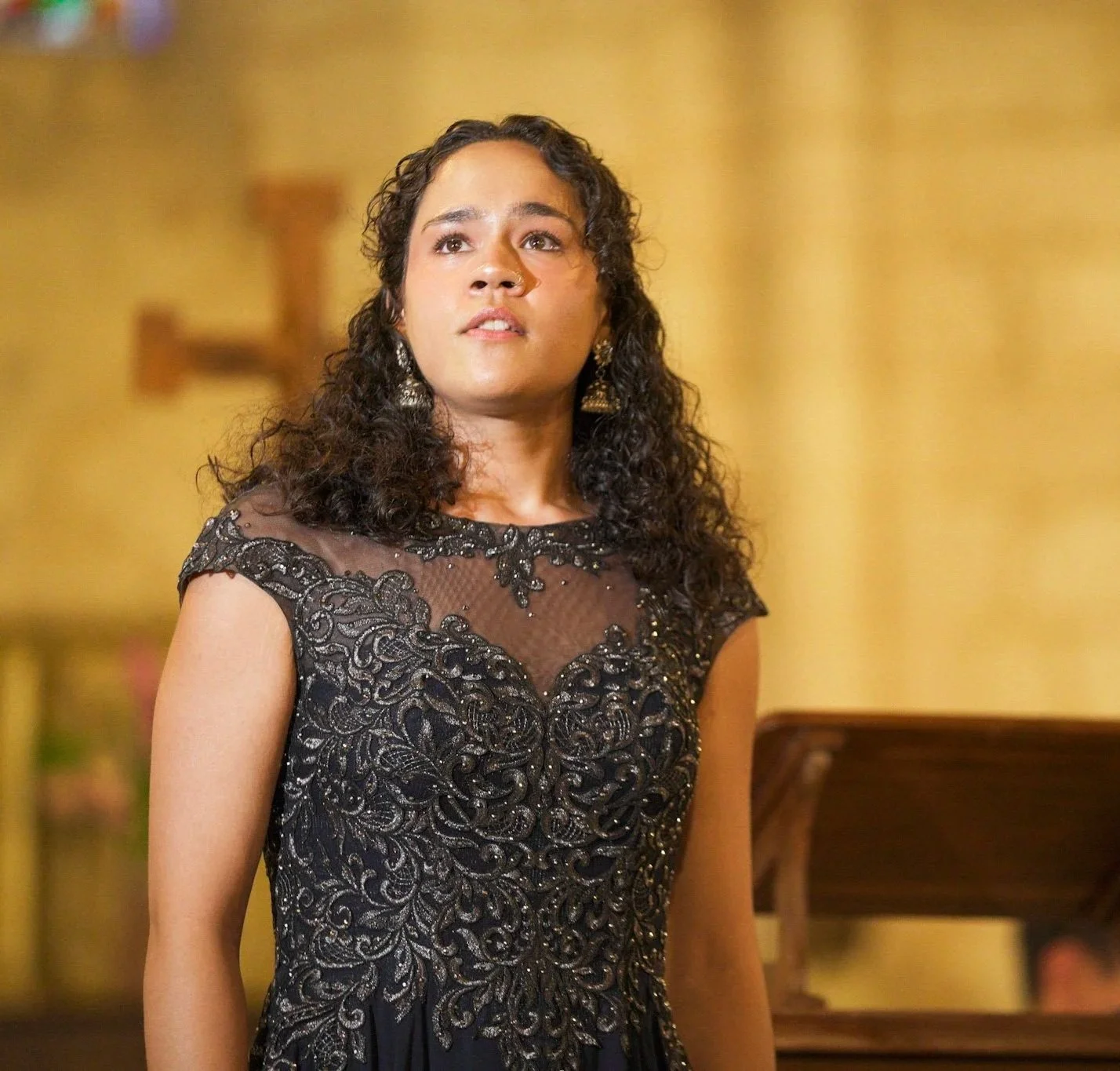
Nazmee Kamal
When I discovered the opportunity to attend Classic Lyric Arts France, I dedicated the remainder of my undergraduate career to preparing myself for a program I knew I would spend a lifetime being thankful for. I had no idea, at the time, just how profoundly two and a half weeks immersed in the world of French classical repertoire would change me; not only as a singer, but also as a musician, an artist, and a person. Looking back, I can say with complete certainty that spending that summer at CLA France was one of the best decisions I have ever made for my artistic growth and confidence.
My journey began at the Bergerac train station, where Glenn greeted me alongside several of my fellow CLA artists. Many of us had met for the first time during the hour-long train ride, and there was an immediate sense of excitement and camaraderie among us. We were all arriving from different places, bringing different experiences, different voices, and different levels of familiarity with French repertoire, but we were about to embark on the same adventure. We stepped into the most beautiful compound, a horse farm surrounded by luxury homes, a private chef, and a saltwater pool. Coupled with the excitement of what was to come, I knew almost immediately that this was going to be a deeply enriching experience.
That excitement was accompanied, however, by a healthy dose of nerves. CLA France was my very first summer program, and I arrived carrying a bit of imposter syndrome. My French repertoire at the time was, to put it mildly, bleak. I was stepping into a program where I would be surrounded by artists who were all talented, curious, and eager to learn. I wondered whether I would be able to keep up. I wanted desperately to learn as much as I could, while also finding my place among my new colleagues.
As it turned out, I had nothing to fear.
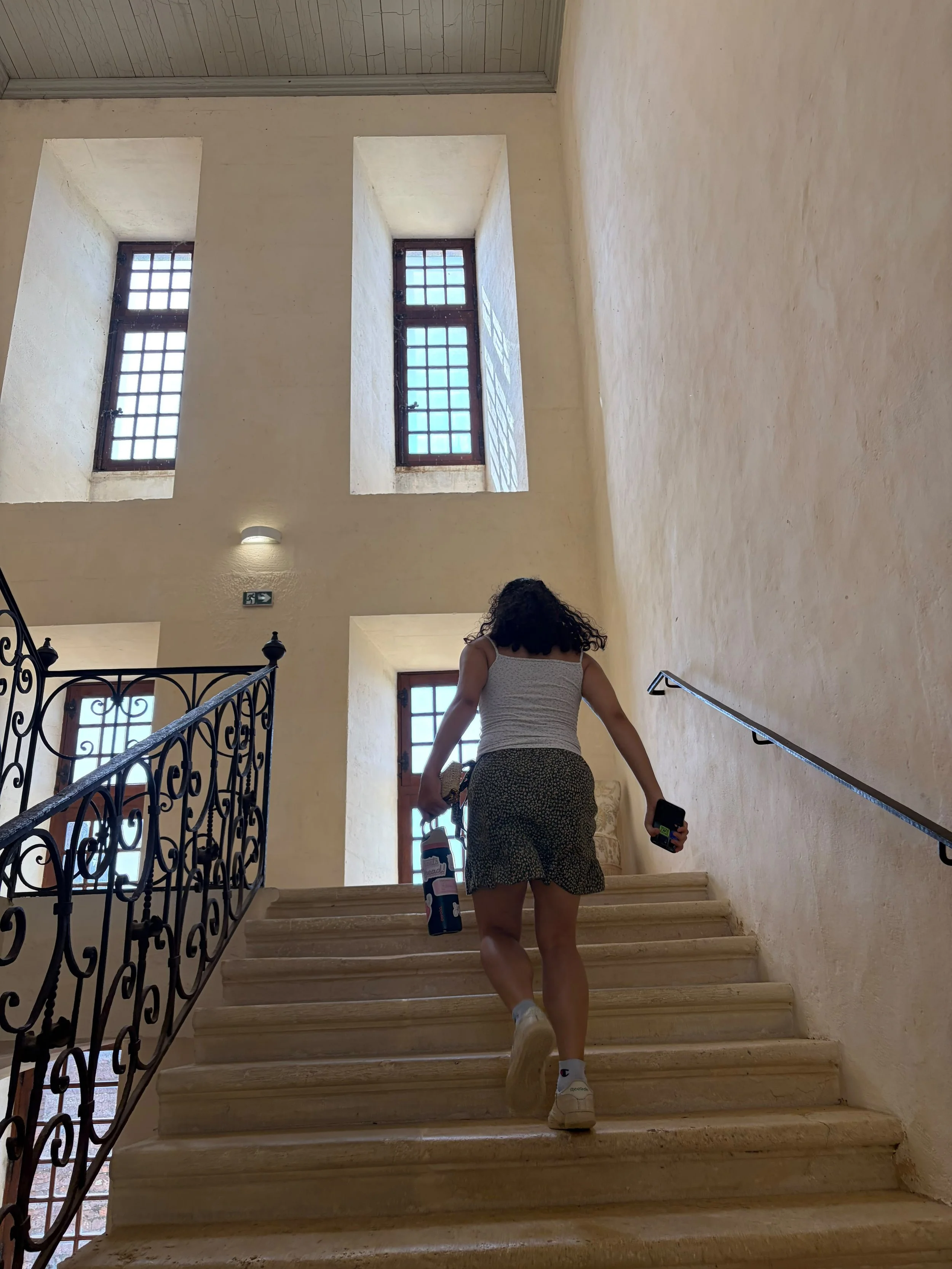
Nazmee in the château
From the very beginning, CLA France fostered an environment where curiosity was valued just as much as accomplishment. I never felt that I needed to arrive already knowing everything. Instead, I was encouraged to ask questions, experiment, make mistakes, and try again. The support I received from the faculty and from my fellow artists slowly lifted me out of that initial place of self-doubt and replaced it with something much more valuable: confidence rooted in curiosity.
One of the greatest gifts of CLA France was the sheer amount of French repertoire I was able to discover. I walked into the program with two French arias and one French art song. I left the program having learned and performed seven French arias and more than fourteen French art songs. I had the chance to study entire roles that I dream of performing someday, including title roles like Carmen and Dalila. Alongside standard repertoire, I was also introduced to composers and works that I had never encountered before. I began to understand that French repertoire is not simply another language in which to sing. It is its own world, with its own particular colors, rhythms, textures, and ways of communicating.
Working with Glenn Morton, CLA’s Founder and Artistic Director, allowed me to step into that world with an entirely new perspective. Glenn taught me to imagine French diction and lyricism as an extension of the body, allowing vowels to live inside the mouth and to trust the words to do the work. Rather than trying to force the music to happen, I learned to let the language lead me toward the music. There was something incredibly freeing about discovering that the text itself could become the foundation for expression.
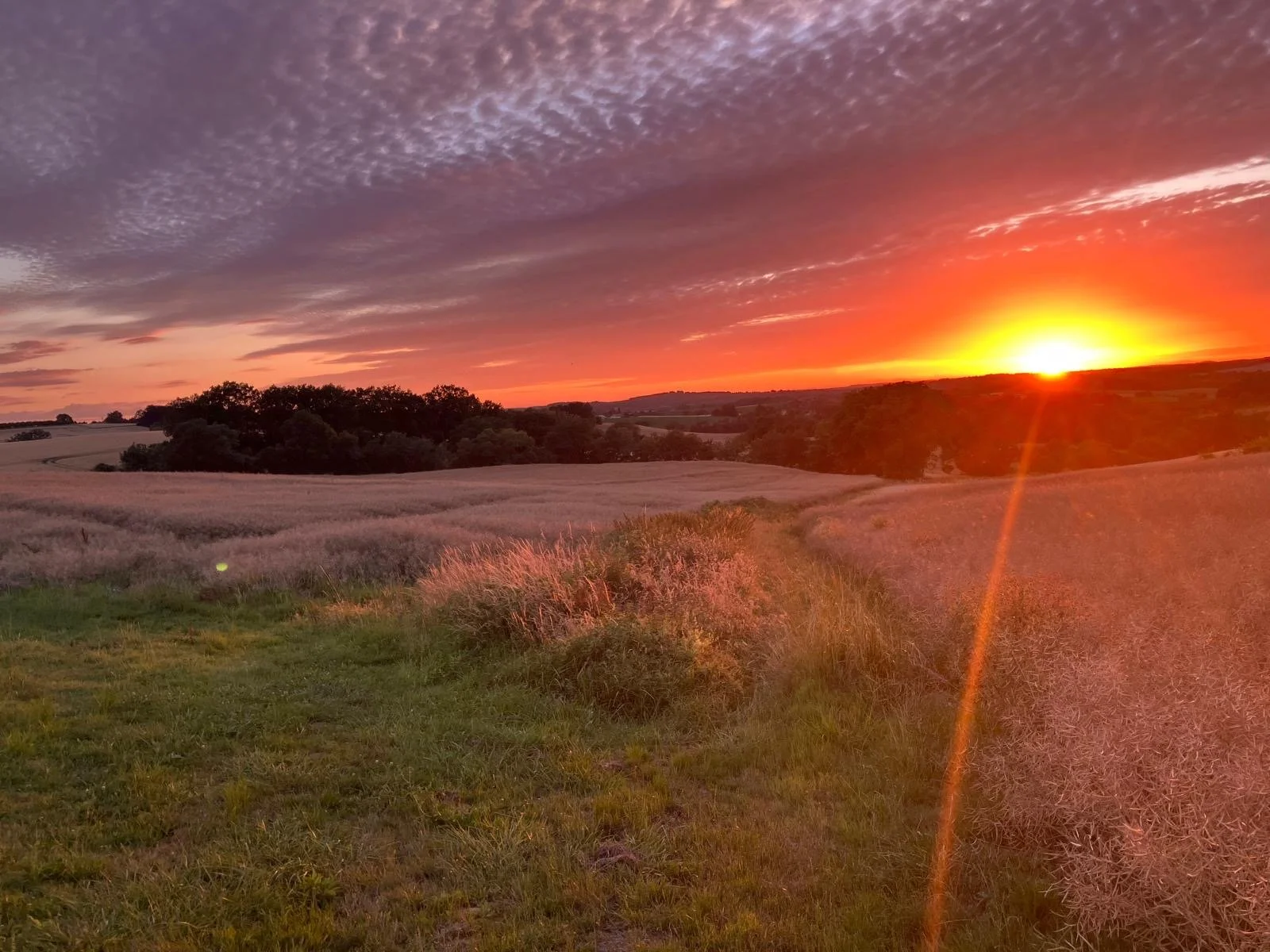
View from La Ferme d’Hermance
French singing is, in many ways, an exercise in listening. Listening to the shape of a word. To the way a vowel resonates. Listening to the relationship between the text and the music and for the emotional intention hidden within a single syllable. The more I took the time to listen, the more I understood that diction is not merely about pronouncing the language correctly; it is about discovering what the composer has given you, and allowing the words to reveal the character, the story, and the music.
Our French language classes with the multifaceted Raphaël Treiner became an essential part of that process. We read and translated poetry, listened to famous French music, and explored the intricacies of inflection and diction. We did not simply learn French so that we could pronounce our words correctly onstage. We learned how the language itself thinks and feels. We explored the importance of where a word falls, how a phrase turns, and what happens when the meaning of a text changes depending on the way it is spoken. I took a liking to the French language in my undergrad, and now I am working to build fluency, thanks to the immersion I experienced at CLA France.
Through our study of composers such as Massenet, Chabrier, Gounod, Debussy, and so many others, I began to understand the incredible relationship between language, intention, and music. We explored acting and text painting, discovering how carefully placed words can reveal the inner lives of characters. A single phrase can tell you what someone wants, what they fear, what they remember, or what they are trying desperately not to say. This was one of the most important lessons I took away from CLA France: that the words are never separate from the music. They are the music.
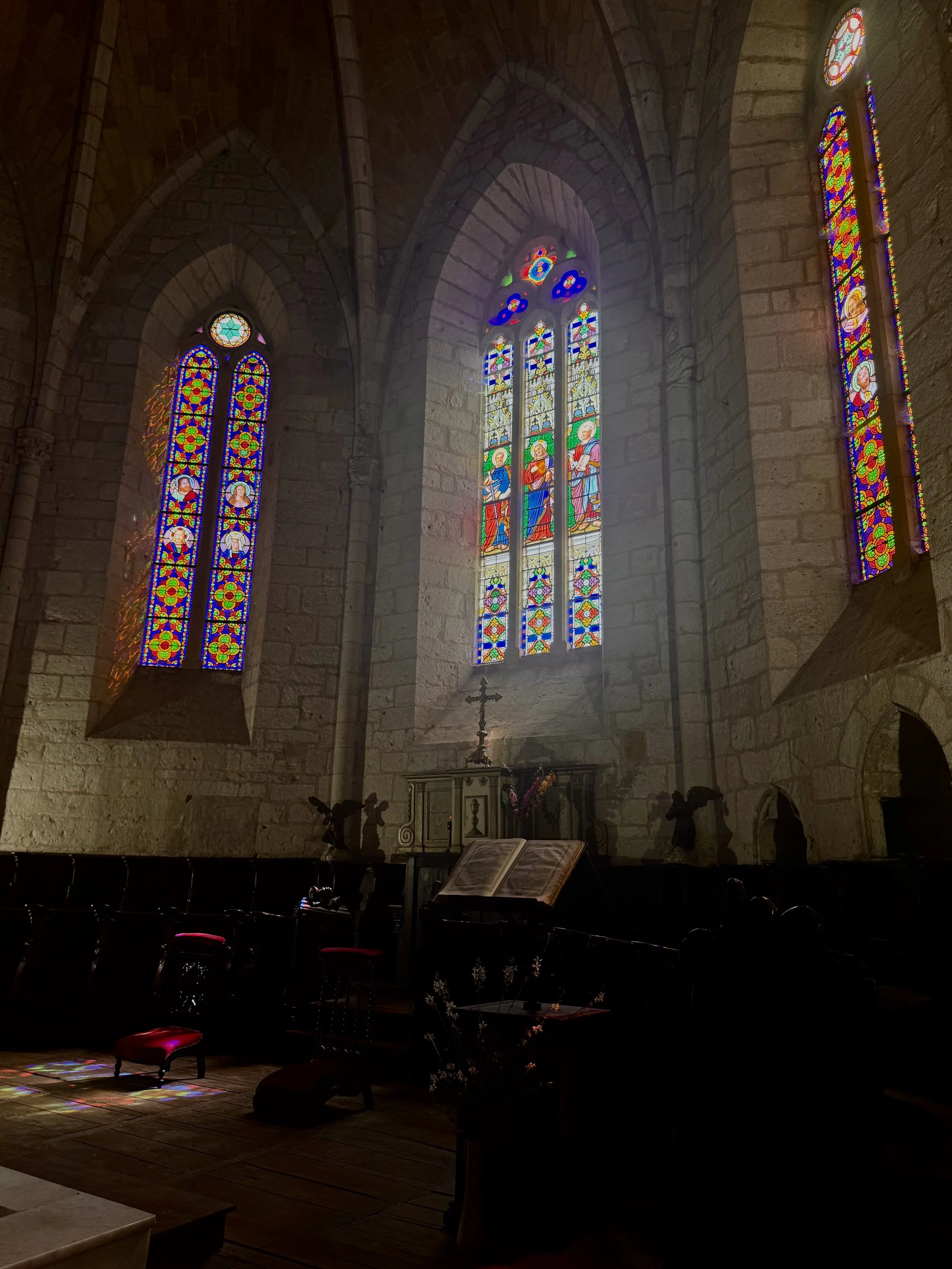
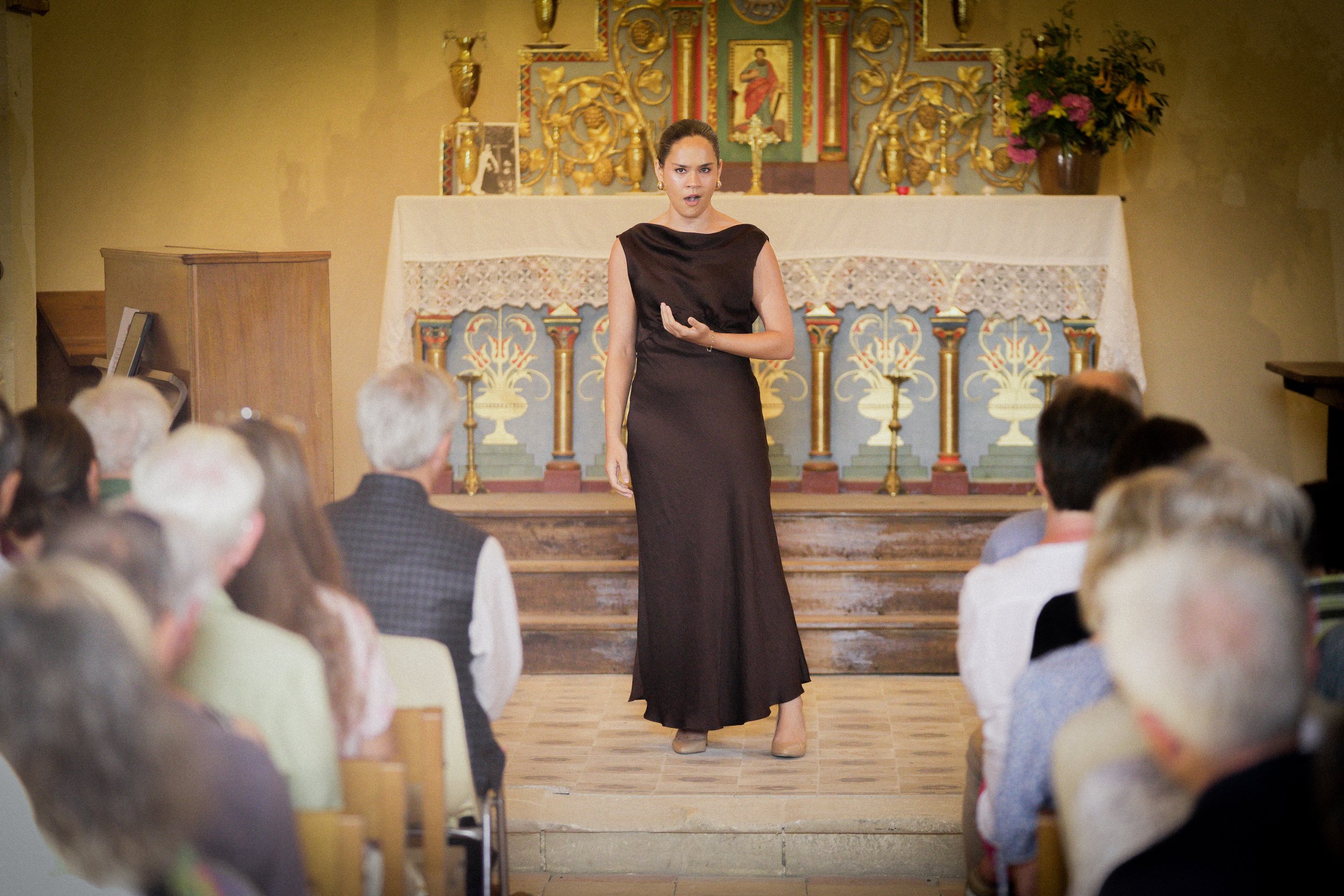
2026 CLA France performance venue: Monpazier Église Saint Dominique
I was also fortunate to work with Hélène Blanic, an extraordinary pianist, coach, and singer extraordinaire. Her knowledge of French, German, and Italian repertoire seemed almost limitless. She possesses one of the most phenomenal musical brains I have ever encountered, and every coaching session with her felt like opening a door into an enormous library of knowledge. Through our work together, I found new extensions in my voice, greater confidence in my musicianship, and a deeper understanding of music that could never have been introduced to me in a classroom setting. There is something special about working one-on-one with a musician who can hear possibilities in you that you have not yet discovered for yourself. Hélène helped me find those possibilities. She challenged me, encouraged me, and gave me tools that I know I will continue to use throughout my career.
And then there were the roles.
I had the incredible opportunity to debut characters who had lived in my imagination long before I ever had the chance to sing them. I performed Le Prince Charmant from Massenet's Cendrillon and Mélisande from Debussy's tragic opera, Pelléas et Mélisande. To step into these characters, to explore their stories, their desires, their vulnerabilities, was a dream come true. I was surrounded by beautiful historic churches, extraordinary colleagues, and music that seemed to transport all of us into other worlds: worlds of fantasy, romance, devotion, longing, and myth. Every performance felt like an invitation to step outside of myself.
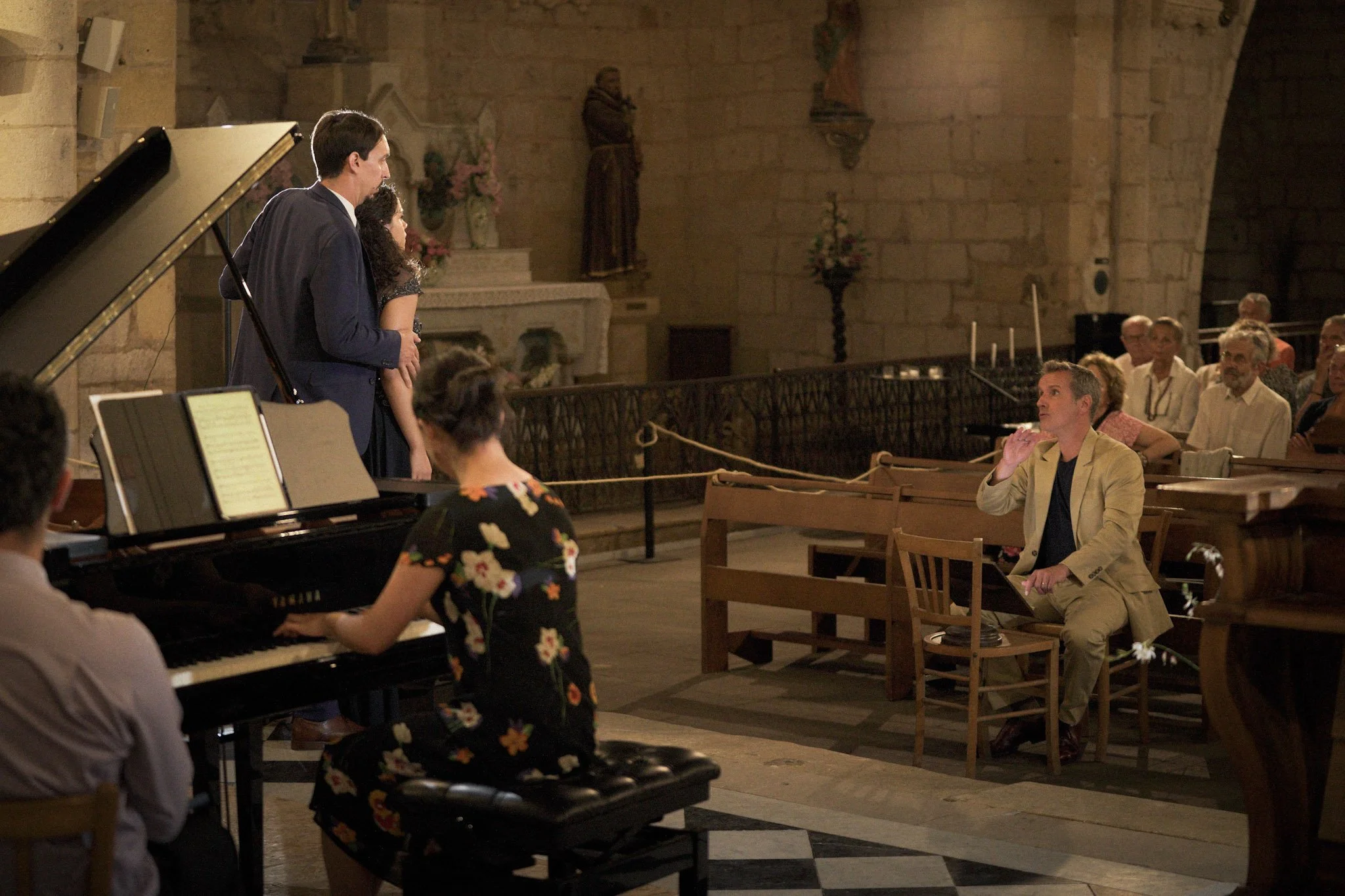
Nazmee, Geoffrey Schmeltzer, Amber Scherer, and Gaspard Brecourt during a performance
When our first concert finally arrived, I had the opportunity to make my France debut singing one of my favorite arias, "Je suis Lazuli" from Emmanuel Chabrier's L'Étoile. By that point, I felt so immersed in the language and culture of French music that I could step onto the stage and trust what I had learned. I felt connected to the character and to the words, and I began to understand the unique joy of performing music that, only a few weeks earlier, had felt entirely foreign to me. The concerts that followed gave me another invaluable teacher: the experience of sharing this music with an audience.
Throughout the program, I leaned on our phenomenal Maestro, Gaspard Brécourt, who taught us to take our time and to offer our very best to the people watching. He encouraged us to understand why our characters felt compelled to share their stories in the first place. More importantly, he encouraged us to ask ourselves the same question: Are we singing to express, or are we singing to impress?
The answer, every time, had to be the former.
It is so easy, especially as a young singer, to become caught up in the desire to prove yourself. To sing the high note perfectly. To impress the panel. To demonstrate that you belong on the stage. But the more I performed at CLA France, the more I understood that the most meaningful performances were not necessarily the ones in which I felt I had demonstrated the most, they were the ones in which I had given something away.
After our performances, audiences would come up to us and tell us that they had been transported into the worlds of our characters, moved by their stories. Those conversations reminded me why we do this in the first place. We sing to communicate. We sing to tell stories. We sing to make someone else feel less alone. And sometimes, we sing simply because there are things that cannot be said any other way.
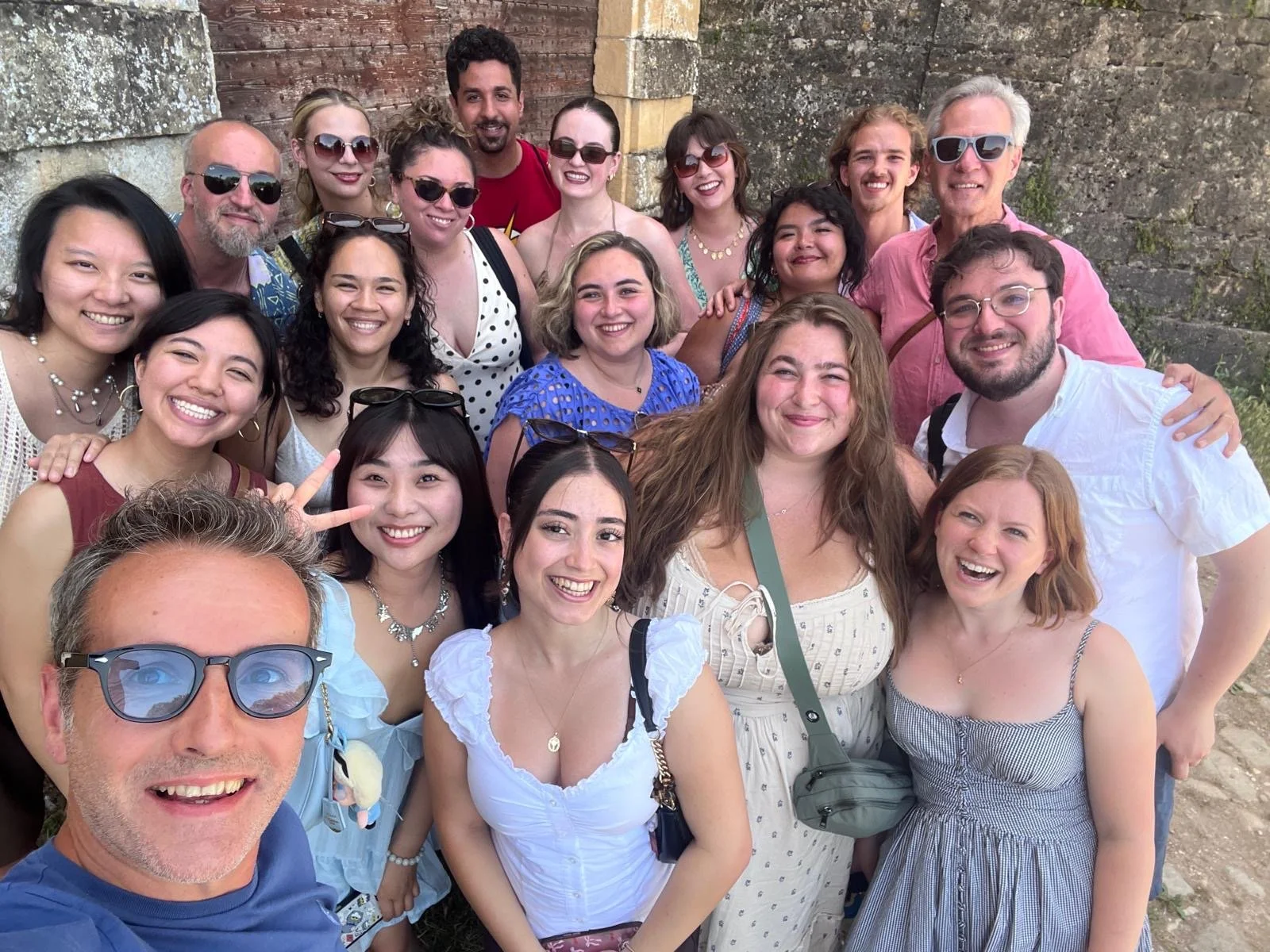
The 2026 CLA France Artists & Faculty
My colleagues became an essential part of that discovery. I arrived at CLA France hoping to learn more about French repertoire, but I left with some of my dearest friends. We supported one another through coachings, rehearsals, language classes, performances, and all of the inevitable moments of uncertainty that come with being a young artist. We celebrated each other's successes and encouraged one another through the difficult moments. There is a particular kind of friendship that forms when you spend your days making art together. You see each other at your most vulnerable. You watch someone struggle through a difficult passage, then witness the moment when it finally clicks. You hear someone sing a role for the first time. You watch a colleague discover something new about themselves onstage. You learn to trust one another.
I found that trust at CLA France. And, perhaps most importantly, I learned to trust myself.
When I think back to the person who arrived at the Bergerac train station, I remember someone who was excited but uncertain. Someone who worried about whether her French repertoire was good enough, whether she would fit in, whether she was prepared to be there.
The person who left CLA France was different.
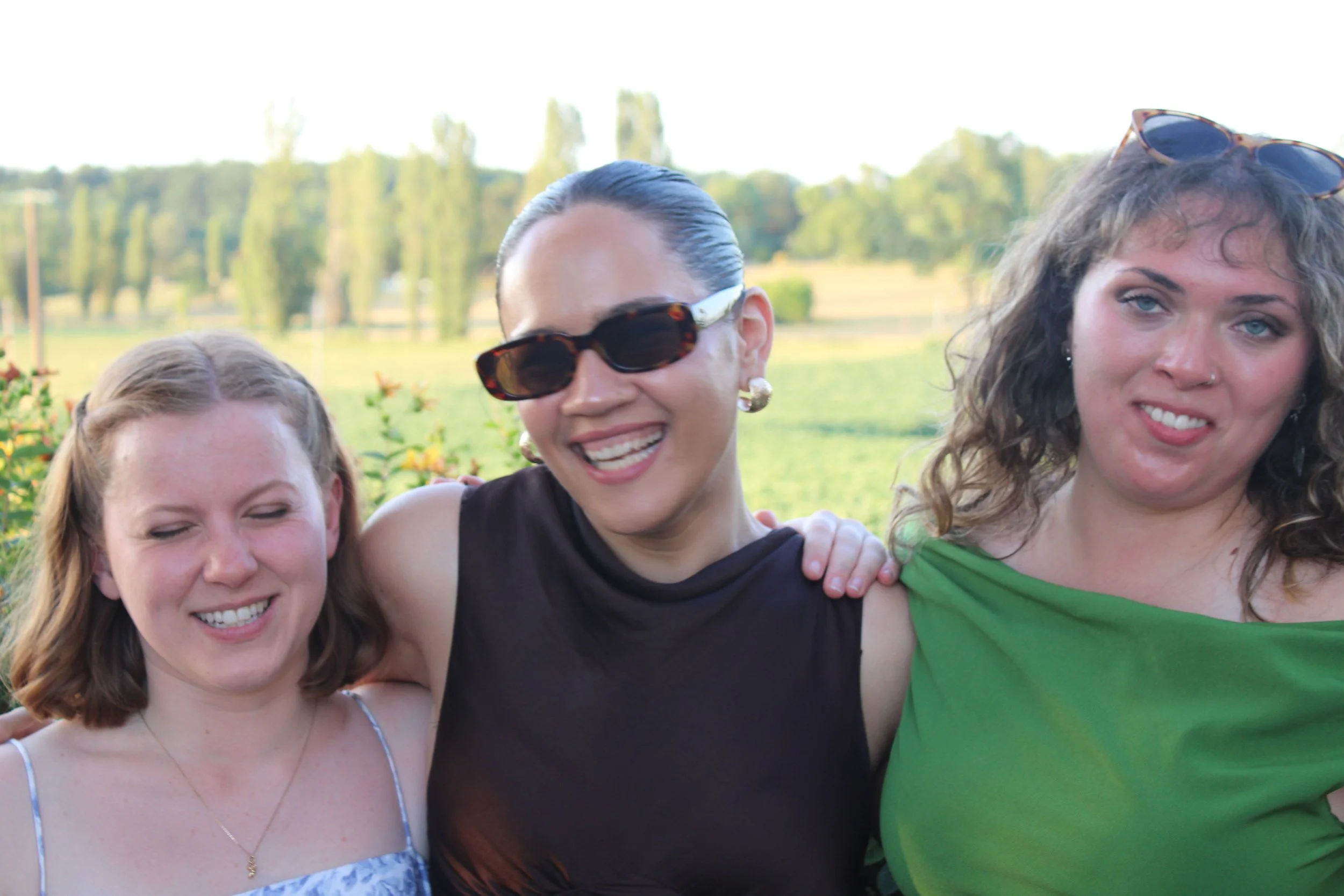
Mina Brooks Schmidt, Nazmee, and Sofia Pandolfo
I left having performed in historic churches across France. I left having explored roles I dream of singing again. I left with a deeper understanding of French diction, lyricism, and repertoire. I left with new friendships, new musical tools, and an entirely new appreciation for the possibilities of my own voice.
In my final days at CLA France, I found myself reflecting on how this experience would shape the decisions I make throughout my career. One thing became increasingly clear to me: to be a true opera singer, a storyteller, a well-rounded musician, and a well-rounded person, you must find empathy in every corner of the music. French opera taught me this in a particularly profound way. The vulnerability I found in this repertoire reminded me that the art composers give us is often rooted in their own experiences of life. Their music carries their fears, their desires, their relationships, their losses, their dreams. Somewhere in the process of creation, they took something deeply personal and placed it on the page for someone else to discover.
What an extraordinary act of courage that is. And who are we, as performers, not to honor that bravery?
When we perform the works of others, we are not simply reproducing notes on a page. We take their lives, their stories, and their characters into ourselves. We allow their experiences to become extensions of our own. We listen, we empathize, and then we curate our own interpretations of these timeless works. That is the responsibility, and the privilege, of being an artist.
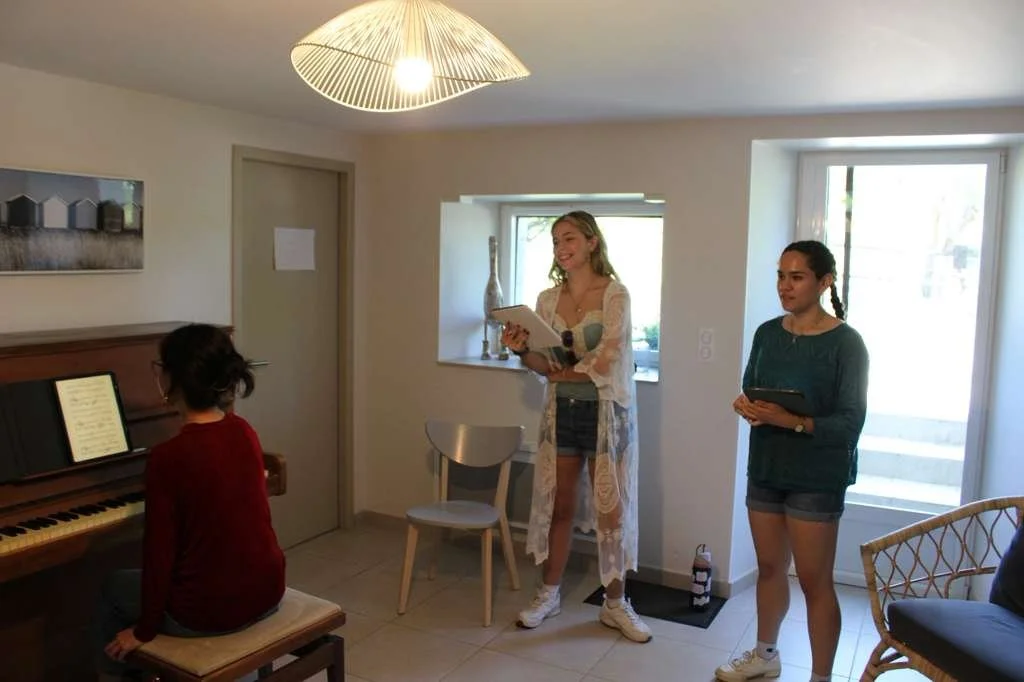
Amber Scherer, Jenna Ferrera, and Nazmee rehearsing
As a fresh graduate of Carnegie Mellon University and someone preparing to begin my Master's degree at the Peabody Institute, I know that I am standing at another crossroads in my artistic journey. The transition from one chapter to the next can be exciting, but it can also be uncertain. There are always more questions than answers: Where will I go? Who will I become? What will I discover? CLA France reminded me that perhaps I do not need to have all of those answers yet. Instead, I can remain curious.
I can listen. I can learn. I can allow the words to live inside my mouth and trust that, eventually, they will tell me where the music needs to go. I can remember that I am not onstage to impress, but to express. Not to prove that I belong, but to share something meaningful with the people who have chosen to listen.
And I can carry with me the empathy that French repertoire taught me; the empathy to step inside another person's story, to honor the lives and experiences that inspired the music, and to recognize the humanity that connects us all.